Battery storage fire and explosion injures four firefighters at Japanese solar site
Mar 2024Published 7 Sept 2026Responsible editor: Chief Editor
- Where
- Takayanagi Solar Power Plant Unit 6, Isa City, Kagoshima, Japan
- Operator
- Hayashi Energy System
- What
- Lithium-ion battery fire and explosion
- Injuries
- Four firefighters injured, one with severe burns to face and hands
- Outcome
- Storage building scorched and deformed; fire out after more than 20 hours
Get the next one by email
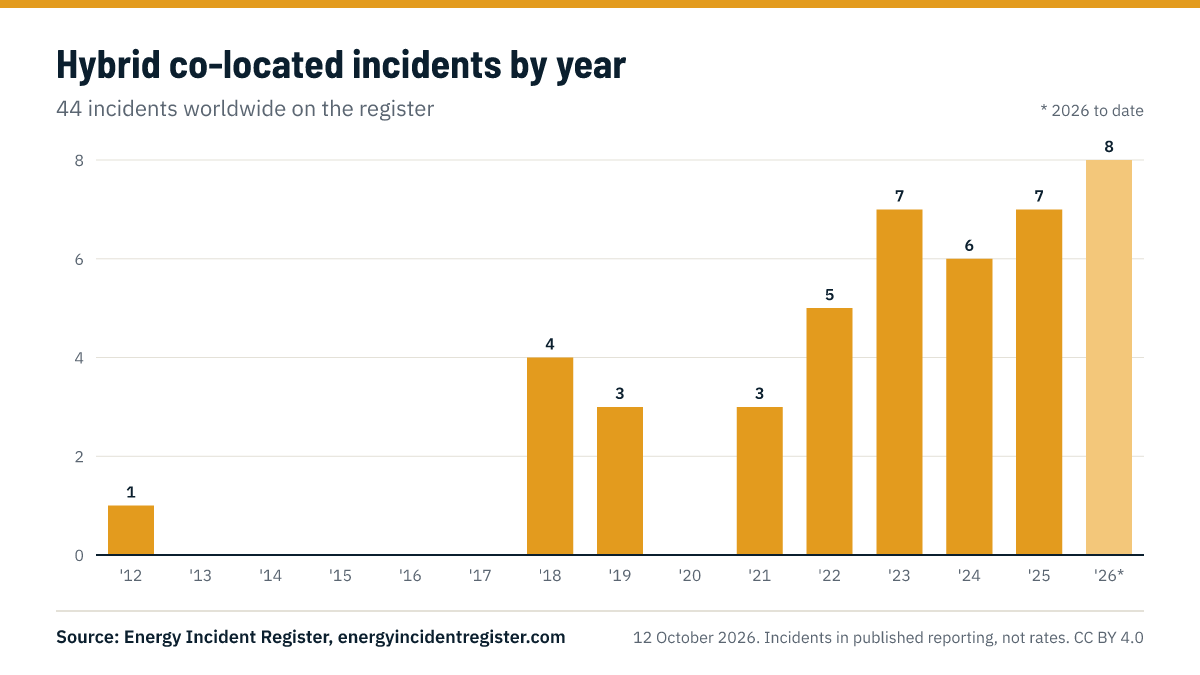
Free alerts on hybrid co-located incidents worldwide, and an email when EIR-0118 is updated. No account needed; unsubscribe in one click.
Confirm your email and every battery storage incident on the register arrives at once as a spreadsheet (CSV), free.
Get a free sample brief Three complete verified records and the incidents-per-GW table, by email within a minute.
We will also email you about the register's paid records and plans, at most once a week and three times in all. You can stop these at any time. By signing up you agree to the privacy policy.
Companies named in the reporting of this entry (being named is not a finding of fault): Hayashi Energy System
What happened
A fire broke out at a lithium-ion battery energy storage system co-located with the Takayanagi Solar Power Plant, Unit 6, operated by Hayashi Energy System in Isa City, Kagoshima, Japan. Neighbours reported white smoke coming from the site. Firefighters could not use water on the fire because of the risk of short circuit and electric shock from the battery equipment. After checking the temperature of the building, firefighters opened the door and found it filled with smoke.
When they attempted to operate the building's smoke exhaust system, an explosion occurred, injuring four firefighters, one of whom sustained severe burns to the face and hands. The fire did not spread to the solar panels but the storage building was scorched and deformed. The fire was confirmed extinguished more than 20 hours after ignition, around 14:30 the following day.
Contributing factors
Water could not be used to fight the fire due to the risk of short circuit and electric shock from the lithium-ion battery equipment, prolonging the incident. An explosion occurred when firefighters attempted to activate the building's smoke exhaust system after opening the door, suggesting a build-up of flammable or explosive gases inside the enclosed structure prior to ventilation.
Lessons learned
- Lithium-ion BESS fires cannot be fought with water because of short-circuit and shock risks, so operators must supply alternative suppression plans to local fire services.
- Opening a BESS enclosure or activating its smoke exhaust after gas build-up can cause an explosion, so responders must follow BESS-specific entry rules.
More lessons on fire suppression and firefighting, emergency response and public communication, from every incident on the register.
Not yet known
- Cause of the fire and explosion
- Battery model, age and capacity
- Cost of damage and downtime
This entry is updated when these are reported. Get an alert for the next one like it.
Source
Published 2026-09-07. Written from public reporting. Descriptive, not investigative. See the data accuracy disclaimer.