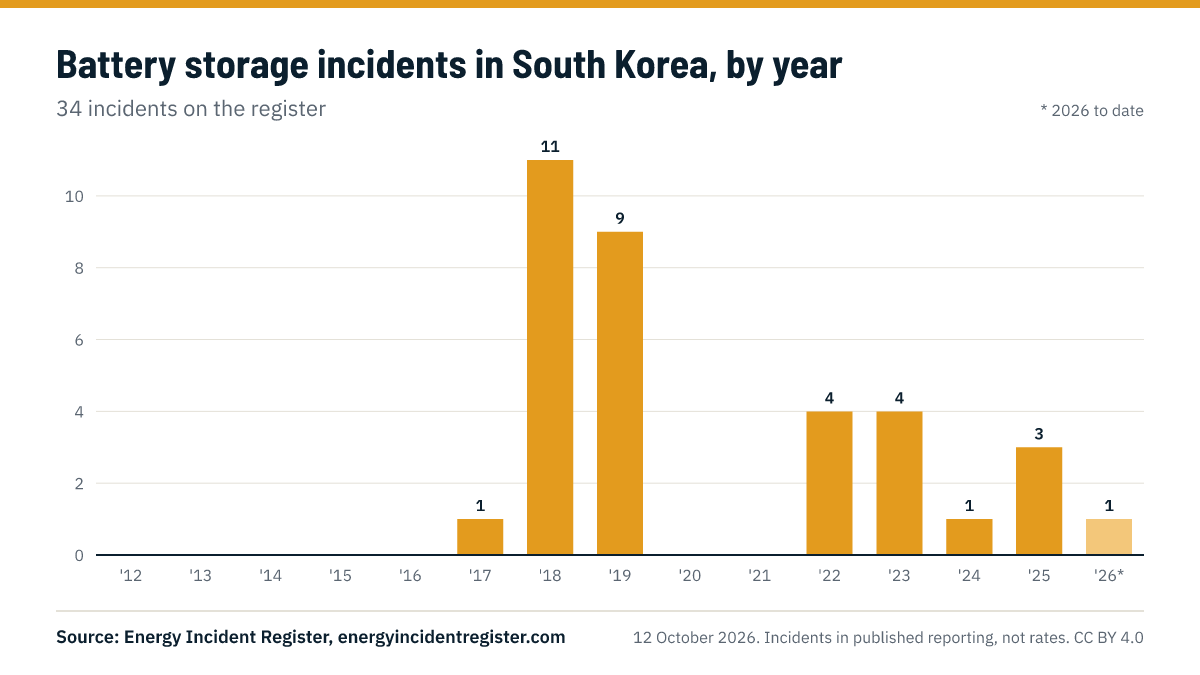
Fire at wind farm battery storage system in Yeongam-gun, South Korea
June 2018Published 11 Sept 2026Responsible editor: Chief Editor
- Where
- Wind power plant, Geummyeon, Yeongam-gun, Jeollanam-do, South Korea
- What
- Fire broke out in BESS building
- Injuries
- None reported
- Response
- Local fire brigade controlled scene by 5:55pm
- Cause
- Under investigation
Get the next one by email
Free alerts on battery storage incidents in South Korea, and an email when EIR-0673 is updated. No account needed; unsubscribe in one click.
Confirm your email and every battery storage incident on the register arrives at once as a spreadsheet (CSV), free.
Get a free sample brief Three complete verified records and the incidents-per-GW table, by email within a minute.
We will also email you about the register's paid records and plans, at most once a week and three times in all. You can stop these at any time. By signing up you agree to the privacy policy.
Companies named in the reporting of this entry (being named is not a finding of fault): Samsung SDI
What happened
On 2 June 2018 at around 4:13pm local time, a fire broke out in a building housing a battery energy storage system inside a wind power plant in Geummyeon, Yeongam-gun, Jeollanam-do, South Korea. The local fire brigade responded and had the scene under control by around 5:55pm. No injuries were reported. Fire authorities stated they believed the fire started in the storage facility, which stored electricity generated by the wind turbines, and said they were investigating the cause and extent of the damage.
The battery system was reportedly around 2.4 years old at the time of the incident and used Samsung SDI NMC lithium-ion cells in an indoor installation supporting wind power integration.
Contributing factors
Not reported beyond the fact that the fire originated within the storage facility; cause was under investigation at the time of reporting.
Lessons learned
- Indoor BESS installations require early thermal monitoring to detect anomalies before fire spreads to the building structure.
- BESS supporting wind integration needs the same detection standards as standalone units to limit fire duration.
- NMC lithium-ion cells in indoor BESS demand published post-incident findings to improve sector learning on thermal risks.
More lessons on detection and monitoring, from every incident on the register.
Not yet known
- Exact cause of the fire
- Extent of damage to the asset
- Duration of system downtime
- Cost of repairs or replacement
This entry is updated when these are reported. Get an alert for the next one like it.
Source
Published 2026-09-11. Written from public reporting. Descriptive, not investigative. See the data accuracy disclaimer.