Fire destroys battery storage building at SeAH Changwon Special Steel plant
Sept 2023Published 7 Sept 2026Responsible editor: Chief Editor
- Where
- SeAH Changwon Special Steel ESS facility, Changwon, South Korea
- Operator
- SeAH Changwon Special Steel
- Manufacturer
- Samsung SDI
- What
- Fire destroyed indoor lithium-ion battery storage building
- Injuries
- None reported
Get the next one by email
Free alerts on battery storage incidents in South Korea, and an email when EIR-0121 is updated. No account needed; unsubscribe in one click.
Confirm your email and every battery storage incident on the register arrives at once as a spreadsheet (CSV), free.
Get a free sample brief Three complete verified records and the incidents-per-GW table, by email within a minute.
We will also email you about the register's paid records and plans, at most once a week and three times in all. You can stop these at any time. By signing up you agree to the privacy policy.
Companies named in the reporting of this entry (being named is not a finding of fault): LS Electric, Samsung SDI, SeAH Changwon Special Steel
What happened
A fire broke out at an indoor lithium-ion battery energy storage system used for peak shaving at the SeAH Changwon Special Steel ESS facility in Shinchon-dong, Seongsan-gu, Changwon, Gyeongsangnam-do, South Korea. The facility, operated and owned by SeAH Changwon Special Steel, used batteries manufactured by Samsung SDI, with LS Electric acting as system integrator and EPC contractor. The system had completed an overnight charging cycle and was preparing to discharge during the following peak period when early signs of a problem were reportedly noticed.
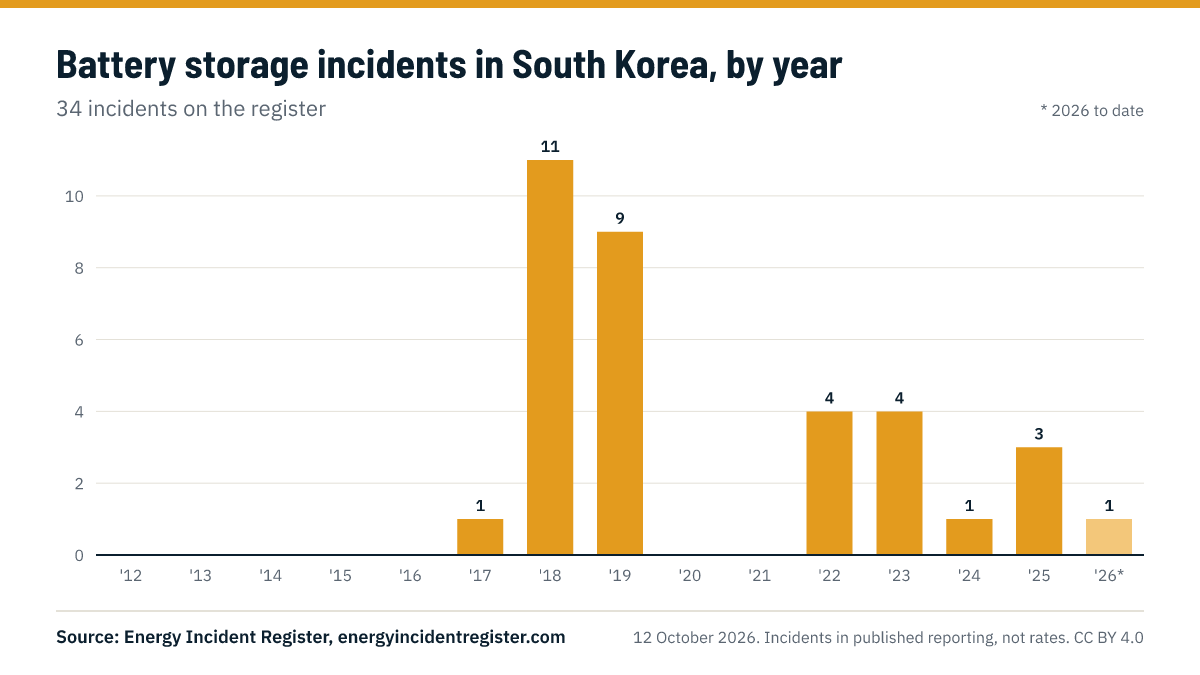
The fire developed fully several hours later and was fought by local fire crews. One battery storage building, housing several thousand lithium-ion cells, was destroyed. No injuries were reported. The incident occurred roughly a month after another large battery storage fire in the same country, prompting renewed concern among experts about the safety of large-scale battery installations, particularly around seasonal periods when ambient temperatures fluctuate significantly.
Contributing factors
Not confirmed by available sources. Commentators noted the fire occurred during a seasonal transition period with variable temperatures and highlighted a recurring pattern of battery storage fires in the region, but no formal root cause had been published at the time of reporting.
Lessons learned
- Lithium-ion battery storage can develop faults after overnight charging and before discharge, so operators should check monitoring systems for early signs during that window.
- A fire in a building with several thousand lithium-ion cells can destroy the structure before crews arrive, so plans must rely on detection and isolation rather than external firefighting.
More lessons on detection and monitoring, from every incident on the register.
Not yet known
- Cause of the fire
- Battery model and age
- Downtime and repair cost
This entry is updated when these are reported. Get an alert for the next one like it.
Source
Other entries that name SeAH
Published 2026-09-07. Written from public reporting. Descriptive, not investigative. See the data accuracy disclaimer.