Tree falling on power lines sparked Colorado's Aspen Acres fire
June 2026Published 16 Oct 2026Responsible editor: Chief Editor
Get the next one by email
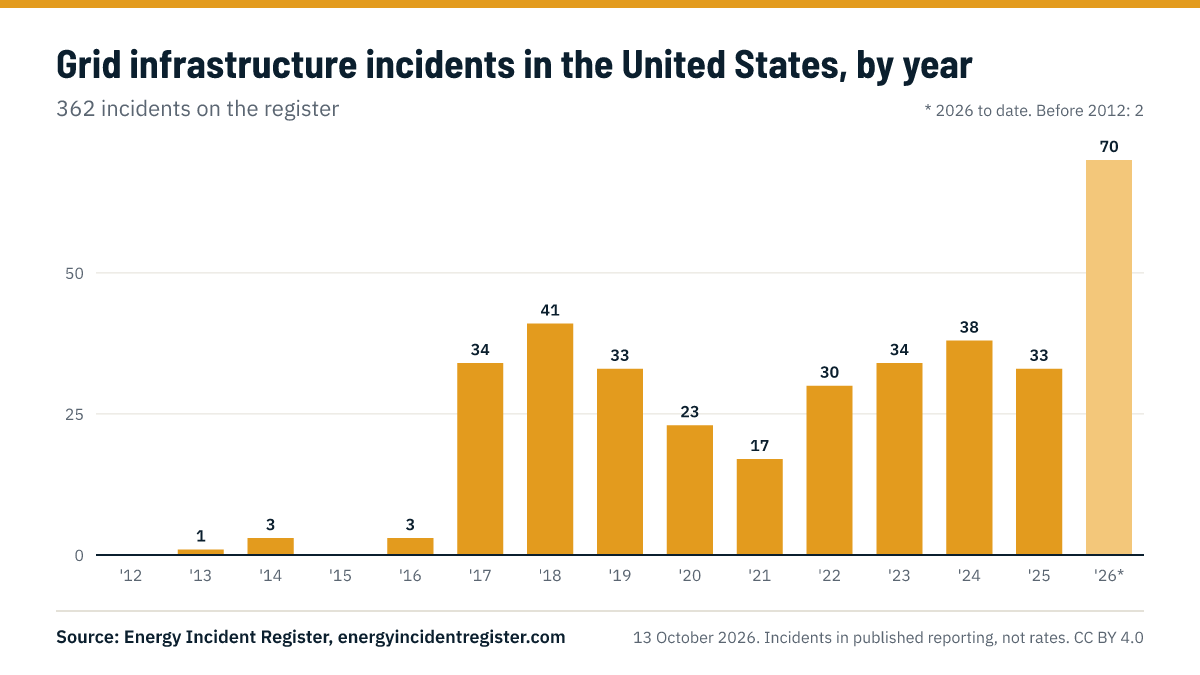
Free alerts on grid infrastructure incidents in the United States, and an email when EIR-2406 is updated. No account needed; unsubscribe in one click.
Get a free sample brief Three complete verified records and the incidents-per-GW table, by email within a minute.
By signing up you agree to the privacy policy.
What happened
On 29 June 2026, an aspen tree blown down by winds of about 45 mph fell across overhead power lines in a forest about 200 feet west of Colorado 165 in Custer County, Colorado. The tree pushed the conductors to within three feet of the ground. Electrical arcing threw sparks that ignited grass, pine needles and low-lying foliage, which burned about one acre before spreading into the Aspen Acres fire.
A state investigation report from the Colorado Division of Fire Prevention and Control concluded that the fire was caused by this contact. The first 911 call was logged at 5:39 a.m. The fire has burned 102,700 acres and destroyed more than 850 structures, including 337 homes. It is the seventh-largest wildfire in Colorado's recorded history.
Contributing factors
Strong winds blew the tree onto the lines. Dry brush and strong winds caused the fire to accelerate. The investigation report states that melted aluminium dripping from the conductor also contributed to ignition. The utility's lines were involved, and the utility faces multiple lawsuits over the origin of the fire. The utility has not commented on the report because of the pending litigation.
Lessons learned
- Vegetation near overhead lines, including trees that could fall in high winds, should be assessed and cleared on a regular schedule, particularly in drought-affected areas.
- Conductors that sag or are displaced by a fallen tree can arc and eject molten metal, so protection settings and fault detection should be reviewed for fast de-energisation.
- Evidence such as failed conductors and vegetation should be preserved under a documented chain of custody so that the cause can be established independently.
More lessons on maintenance, inspection and ageing assets, detection and monitoring, from every incident on the register.
Source
Published 2026-10-16. Written from public reporting. Descriptive, not investigative. See the data accuracy disclaimer.