PG&E reports transmission line malfunction near Kincade fire origin
Oct 2019Published 25 Sept 2026Responsible editor: Chief Editor
- Where
- 230,000 volt transmission line in Geyserville, Sonoma County
- Operator
- Pacific Gas and Electric
- What
- malfunction on a transmission line during a wind event
- Cause
- Under investigation
- Outcome
- line stayed energised
Get the next one by email
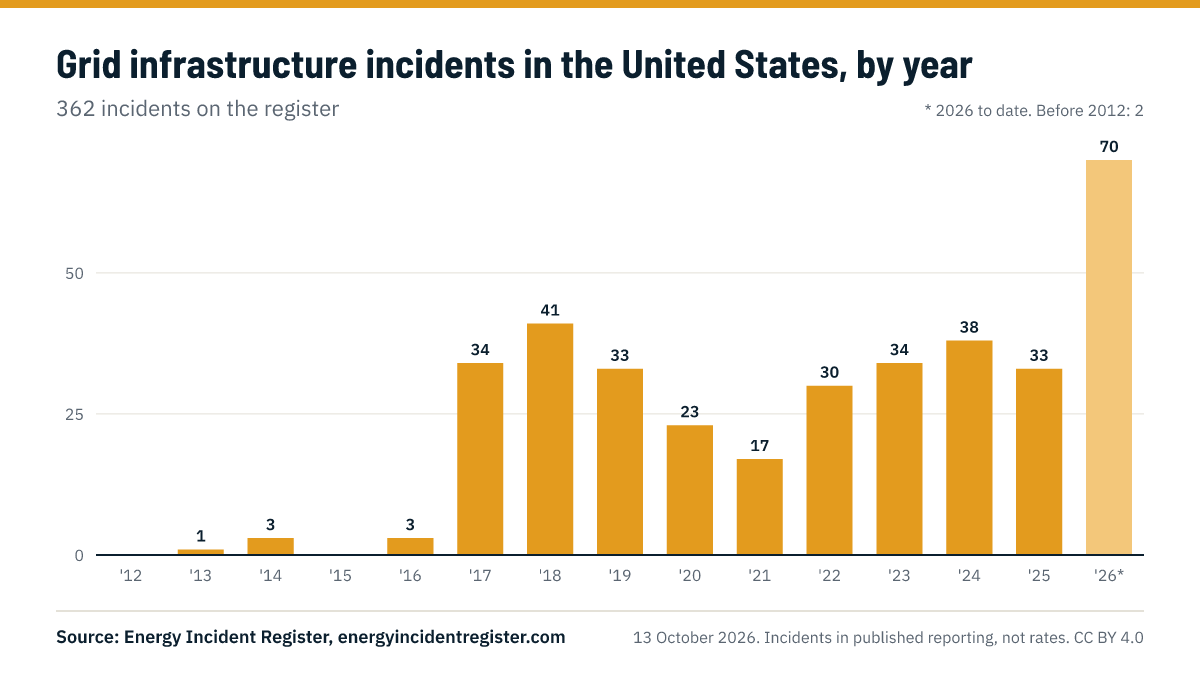
Free alerts on grid infrastructure incidents in the United States, and an email when EIR-1230 is updated. No account needed; unsubscribe in one click.
Confirm your email and every substation and transformer incident on the register arrives at once as a spreadsheet (CSV), free.
Get a free sample brief Three complete verified records and the incidents-per-GW table, by email within a minute.
We will also email you about the register's paid records and plans, at most once a week and three times in all. You can stop these at any time. By signing up you agree to the privacy policy.
Companies named in the reporting of this entry (being named is not a finding of fault): Pacific Gas and Electric
What happened
Pacific Gas and Electric told state regulators that a 230,000 volt transmission line malfunctioned near Kincade Road and Burned Mountain Road in Geyserville, Sonoma County, at about 9:20 p.m. The first calls reporting a major fire followed about seven minutes later. The next morning a Cal Fire crew member pointed out a broken jumper on a transmission tower to a PG&E worker. Lower-voltage distribution lines in the area had been shut off in a public safety power shutdown affecting 27,837 customers, but the high-voltage transmission line had remained energised. PG&E said the filing did not determine the cause of the fire or where it started, and that this remained under investigation.
Contributing factors
The source reports that the transmission line stayed energised during high fire-danger weather because it did not meet PG&E's forecast conditions for a transmission outage. A broken jumper was identified the next morning. Why the line was not inspected for some hours after the failed line was reported was not explained. The report does not establish that the malfunction or the inspection timing caused the fire.
Lessons learned
- A reported transmission malfunction in extreme fire weather should be treated as time-critical until the line condition is confirmed on site.
- Where transmission and distribution de-energisation criteria differ, the reason a line stayed energised should be recorded and explainable.
- A preliminary report to the regulator is not a finding on fire cause or origin; that conclusion belongs to the investigating authority.
More lessons on weather and external hazards, design, standards and commissioning, from every incident on the register.
Not yet known
- Cause of the fire
- Where the fire started
- Time taken for company inspection
This entry is updated when these are reported. Get an alert for the next one like it.
Source
Published 2026-09-25. Written from public reporting. Descriptive, not investigative. See the data accuracy disclaimer.