Battery storage fire at Chaumont Site 1 prompts shelter-in-place order
July 2023Published 7 Sept 2026Responsible editor: Chief Editor
- Where
- Town of Lyme, Chaumont, Jefferson County, New York, United States
- Operator
- Convergent Energy and Power
- Owner
- NSF Chaumont Site 1
- Manufacturer
- GE
- What
- Fire at outdoor battery energy storage system
Get the next one by email
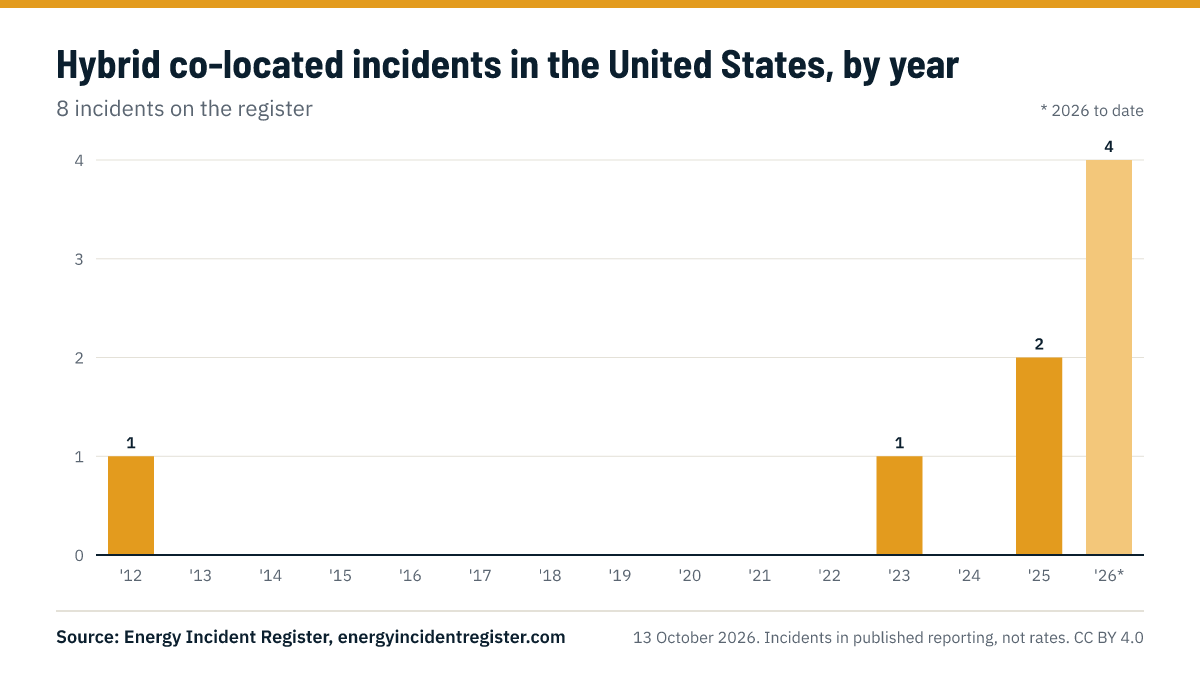
Free alerts on hybrid co-located incidents in the United States, and an email when EIR-0125 is updated. No account needed; unsubscribe in one click.
Confirm your email and every battery storage incident on the register arrives at once as a spreadsheet (CSV), free.
Get a free sample brief Three complete verified records and the incidents-per-GW table, by email within a minute.
We will also email you about the register's paid records and plans, at most once a week and three times in all. You can stop these at any time. By signing up you agree to the privacy policy.
Companies named in the reporting of this entry (being named is not a finding of fault): Convergent Energy and Power, NSF Chaumont Site 1
What happened
In 2023 a fire was reported at an outdoor battery energy storage system co-located with a solar photovoltaic array at the Chaumont Site 1 / Tops Markets solar-plus-storage project in the Town of Lyme, Chaumont, Jefferson County, New York, United States, operated and integrated by Convergent Energy and Power and owned by NSF Chaumont Site 1. The storage system, supplied by GE, used nickel manganese cobalt (NMC) cells and was a small utility-scale installation of single-digit megawatts with a few hours of duration.
Available sources indicate the system had been in service for less than six months, and it is not clear whether the wider project had reached full commercial operation. Local authorities issued a precautionary shelter-in-place order for residents within about one mile of the site while the fire was dealt with. Reported physical damage was limited to part of the installation. No injuries or fatalities were reported in available sources.
Contributing factors
Not reported in available sources. Sources noted only that the system was recently installed, in service for less than six months, with some ambiguity over whether construction and commissioning were fully complete.
Lessons learned
- Where a new battery system is in its first months of service, agree in writing which party monitors cell data and who may isolate the unit out of hours.
- Emergency plans for storage sites near housing must set trigger conditions and communication routes for shelter-in-place orders in advance.
- At co-located solar and storage sites, response plans must cover how to isolate direct current sources that remain live in daylight.
More lessons on detection and monitoring, emergency response and public communication, electrical protection and isolation, from every incident on the register.
Not yet known
- Exact cause of the fire
- Battery model and cell age
- Duration of outage and cost of damage
- Whether the project had reached full commercial operation
This entry is updated when these are reported. Get an alert for the next one like it.
Source
Published 2026-09-07. Written from public reporting. Descriptive, not investigative. See the data accuracy disclaimer.